`It was a brisk Monday morning when I received an urgent call from a local bakery owner in New York City. Her voice was filled with anxiety as she explained that she had been receiving several negative reviews on her Google Business Profile that she suspected were fraudulent. These reviews, she claimed, came from individuals who had never set foot in her bakery. As she spoke, I couldn't help but recall a similar situation I encountered early in my career, where a restaurant faced a sudden drop in customers due to a flood of malicious reviews. For business owners, understanding Google's review removal policy is not just important it's imperative. As someone who has spent over a decade helping businesses navigate the complexities of online reputation management, I understand the critical role that reviews play.
For many business owners like the one I spoke with, a pristine online reputation can mean the difference between thriving and barely surviving. In today's digital age, reviews are often the first impression potential customers have of a business. Knowing what kinds of reviews can be removed and how to go about it can dramatically alter the outcome of a business owner's efforts to safeguard their reputation. In this article, we’ll delve into the intricacies of Google's review removal policy, explore what types of reviews can be deleted, and why understanding these guidelines is essential for maintaining a healthy online presence.
By the end of this article, you’ll not only have a clear understanding of what Google allows for removal but also why it matters and how you can leverage this knowledge to protect your business. So, let's dive in and unravel the complexities of Google's review removal policy a topic every business owner should be well-versed in.
Understanding Google's Review Removal Guidelines
Google's review removal process is guided by a comprehensive set of rules and standards, primarily encapsulated in their Prohibited and Restricted Content policy. These guidelines are designed to ensure that reviews on the platform are fair, relevant, and accurate. From my experience working with hundreds of businesses, I've observed that understanding these policies is crucial for any business looking to maintain a positive online image.
According to Google's policies, content that is fake, irrelevant, or deceptive is subject to removal. This includes reviews that are not based on a genuine customer experience or are part of a coordinated attack. For instance, if a competitor is attempting to damage your reputation with false reviews, these would fall under Google's purview for removal. Similarly, reviews that include hate speech, discriminatory remarks, or explicit content are strictly prohibited and can be flagged for deletion.
It's important to note that Google’s policy also extends to conflicts of interest. Reviews written by current or former employees or business owners themselves are considered breaches of their guidelines. In one memorable case, a client of ours discovered that a former employee had left a series of negative reviews across multiple platforms. By referencing Google's policies, we were able to have these reviews removed, thus restoring the business’s reputation.
Not all negative reviews qualify for removal, however. Reviews that reflect a customer's genuine dissatisfaction are typically protected under Google's guidelines. This means that businesses must address these reviews through customer service and engagement rather than removal requests. Understanding these nuances is key to navigating Google’s review landscape effectively.
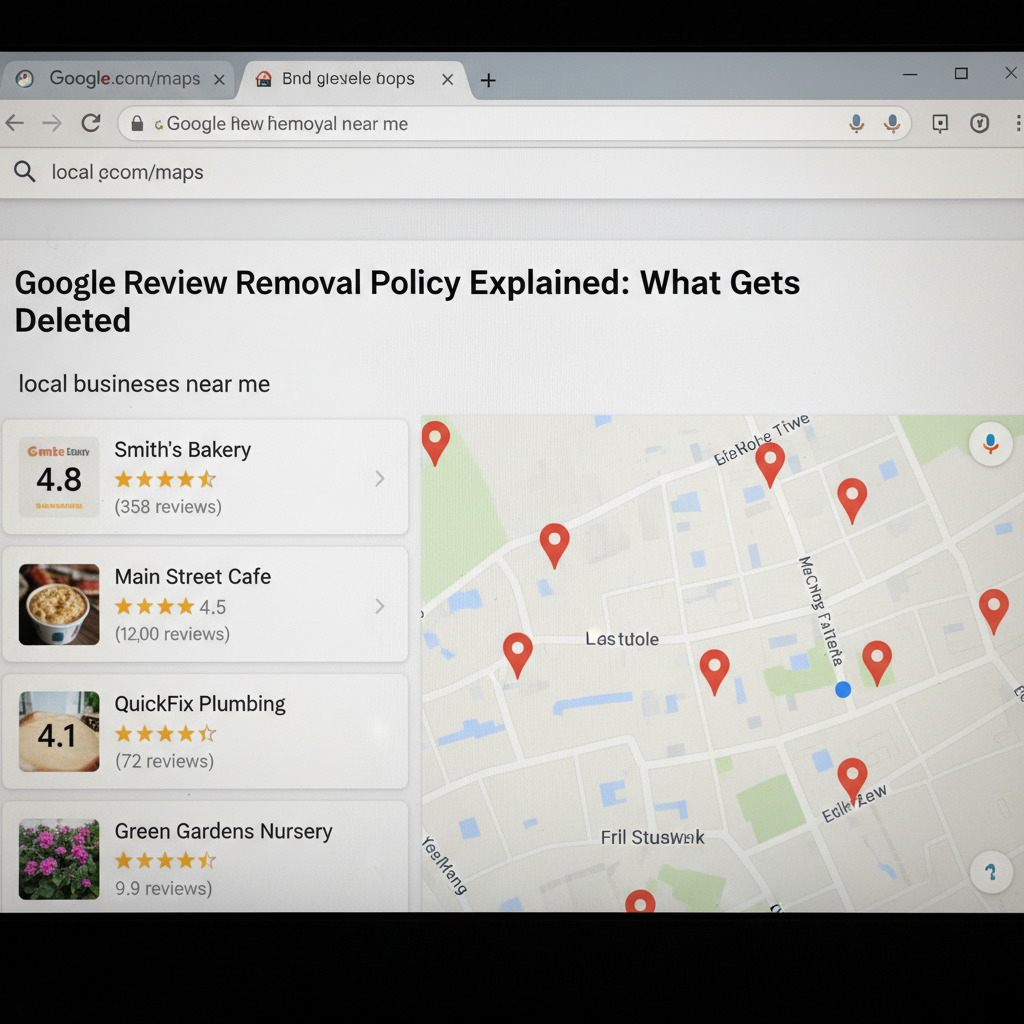
Google Maps search results showing local business ratings - Google Review Removal Policy Explained: What Gets Deleted
Types of Reviews That Can Be Removed
From my experience, there are several categories of reviews that fall under Google's removal guidelines. These include:
Spam and Fake Content: Reviews that are posted with the intention of manipulating ratings are prohibited. This includes reviews from fake accounts or those posted by individuals who have not interacted with the business.
Offensive Language and Hate Speech: Any review containing offensive language, hate speech, or discriminatory remarks is liable for removal.
Conflict of Interest: Reviews from business owners, employees, or anyone with a vested interest in the business are not allowed.
Irrelevant Content: Reviews that are unrelated to the actual customer experience, such as political or social commentary, are eligible for removal.
Personal Information: Google prohibits the posting of personal information such as addresses, phone numbers, or credit card details within reviews.
These categories are clearly defined within Google’s official guidelines, making it easier for businesses to identify which reviews may be eligible for removal. However, the process of actually getting a review removed requires specific actions and adherence to Google’s protocols.
Steps to Request Review Removal
Once you've identified a review that violates Google's policies, the next step is to report it through Google My Business. The process involves the following steps:
Sign in to your Google My Business account.
Select the location you'd like to manage.
Locate the review in question and click on the three-dot menu.
Select “Flag as inappropriate” and follow the prompts to submit your request.
It's vital to provide as much detail as possible about why the review should be removed, referencing specific sections of Google's policies when applicable. While Google typically responds within a few business days, the process can sometimes take longer depending on the complexity of the case.

Dashboard showing review removal results and success metrics - Google Review Removal Policy Explained: What Gets Deleted
Challenges and Limitations of Google's Review Removal Process
While Google's review removal system is robust, it is not without its challenges. One of the most common frustrations I hear from clients is the length of time it can take for reviews to be evaluated and removed. In some cases, it may take weeks or even months for a resolution, particularly if the review in question is borderline in terms of policy violation.
Another challenge is the lack of transparency in decision-making. Google does not always provide detailed explanations for why a review removal request was denied. This can be frustrating for business owners who are confident that a review violates Google's guidelines. It underscores the importance of submitting thorough and well-documented requests that clearly align with Google's policies.
Moreover, Google's automated systems, while efficient, are not infallible. There have been instances where legitimate reviews were mistakenly removed, or fraudulent ones were overlooked. Businesses must remain vigilant and proactive, regularly monitoring their review profiles to ensure their online reputation is accurately represented.
Despite these challenges, Google's review removal process remains an essential tool for businesses seeking to maintain a fair and honest online presence. By understanding the system's limitations and working within its parameters, businesses can effectively manage their online reputation.
Proactive Reputation Management Strategies
Beyond requesting review removals, businesses should also focus on a proactive approach to reputation management. This involves encouraging satisfied customers to leave positive reviews and responding promptly and professionally to all feedback—whether positive or negative. By cultivating a positive online presence, businesses can mitigate the impact of occasional negative reviews.
From my experience, businesses that actively engage with their customers online tend to see a more balanced and favorable review profile. This engagement demonstrates a commitment to customer satisfaction and can even turn a dissatisfied customer into a loyal advocate. Additionally, regularly monitoring your Google Business Profile and addressing any issues as they arise can prevent small problems from escalating.
Implementing these strategies not only helps in managing reviews but also contributes to improving search engine rankings. Google values businesses that actively engage with their audience, and this activity can enhance your visibility in local search results.
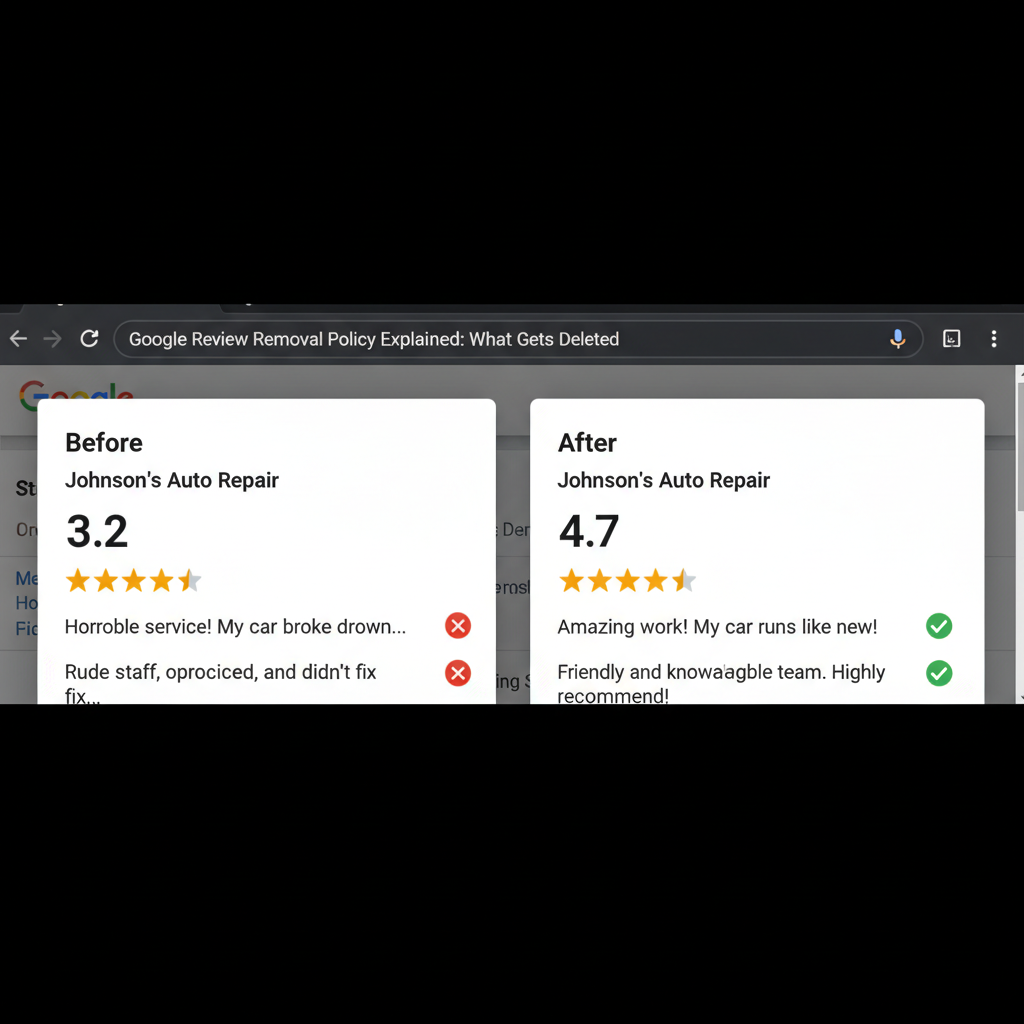
Before and after comparison showing improved business ratings - Google Review Removal Policy Explained: What Gets Deleted
Frequently Asked Questions
What types of reviews does Google remove?
Google removes reviews that violate their guidelines, such as those that contain spam, fake content, offensive language, or personal information. Reviews that represent a conflict of interest or are irrelevant may also be removed.
How long does it take for Google to remove a review?
The review removal process can take anywhere from a few days to several weeks, depending on the complexity of the case. It's important to submit a detailed request and be patient while waiting for a response.
Can I remove negative reviews that are true?
Generally, Google does not remove reviews that are genuine reflections of a customer's experience, even if they are negative. It's recommended to address these reviews through customer service and engagement.
What should I do if Google denies my review removal request?
If your request is denied, review the guidelines to ensure the review truly violates them. If so, consider resubmitting with additional information or engaging with the reviewer to resolve the issue directly.
Does removing reviews affect my business ranking on Google?
While removing inauthentic or violating reviews can improve your perceived reputation, Google rankings are influenced by a variety of factors, including overall engagement and profile activity.
How can I encourage more positive reviews?
Encourage satisfied customers to leave reviews by making the process easy and thanking them for their feedback. Personal requests and follow-ups can also increase review submission rates.
Is there a way to dispute a review if it's removed mistakenly?
If a legitimate review is mistakenly removed, you can contact Google support to dispute the removal. Provide any evidence or context that supports the review's authenticity.
Conclusion
In the complex world of online reputation management, understanding and navigating Google's review removal policy is crucial for any business owner. From addressing fake reviews to knowing what constitutes a policy violation, this knowledge empowers businesses to protect and enhance their online presence. While challenges exist, a proactive approach coupled with a clear understanding of Google's guidelines can ensure that your business maintains a fair and accurate representation in the digital marketplace.
As we've explored, maintaining a healthy online reputation requires both reactive and proactive strategies. By staying informed and engaged, businesses can not only mitigate the impact of negative reviews but also foster a positive and enduring relationship with their customers. Should you need assistance with this process, consider reaching out to our experts or explore our negative review removal service to learn how we can help safeguard your business’s reputation.