AI-Generated Review Detection: Google’s 2025–2026 Enforcement Strategy
Earlier this year, during a quarterly review session with a long-term client an upscale boutique hotel in New York a startling revelation emerged. The marketing manager expressed doubts over the authenticity of several glowing five-star reviews that had surfaced on their Google Business Profile. These reviews, unbeknownst to them, were likely generated by AI, posing a potentially damaging scenario if discovered by discerning guests or Google's sophisticated algorithms. Their situation is not unique, as businesses across the globe grapple with the dual edged sword of AI-generated reviews, which can both bolster and undermine a brand's credibility.
For business owners, the prospect of AI-generated reviews might seem like a double-edged sword. While the allure of effortlessly generating positive feedback is tempting, the risk of being caught and penalized is a looming threat. Google's new enforcement strategy for 2025–2026 aims to crack down on this very issue, utilizing advanced machine learning algorithms to detect and flag such reviews. Understanding these enforcement strategies is crucial for businesses aiming to maintain a genuine and trustworthy online presence.
Drawing from our experience spanning over a decade in online reputation management, we’ve assisted hundreds of businesses in navigating the complexities of Google’s review policies. Our team has witnessed firsthand the dramatic impact of AI-generated reviews both positive and negative. This article delves into Google's upcoming strategies for detecting AI-generated reviews, the implications for businesses, and proactive measures you can take to safeguard your reputation. Armed with this knowledge, you'll be better prepared to align with Google's stringent reviews policy, ensuring your business remains in good standing.
In the sections that follow, we will explore the mechanics of Google's detection technologies, the potential penalties for non compliance, and strategies to ensure your business isn't inadvertently caught in the web of AI-generated reviews. We'll also share actionable steps on how to maintain a stellar online reputation in this new era of digital scrutiny.
Google Maps search results showing local business ratings - AI-Generated Review Detection: Google’s 2025–2026 Enforcement Strategy
Understanding Google’s Detection Technology
The sophistication with which Google plans to tackle AI-generated reviews in 2025–2026 is nothing short of groundbreaking. Leveraging their advancements in natural language processing (NLP) and machine learning, Google's algorithms can now discern subtle patterns indicative of AI-generated content. These include unnatural phrasing, repetitive syntax, and an overuse of certain keywords that don't align with organic human speech patterns.
Google's Detection AI is designed to differentiate between genuine user generated content and AI-generated reviews by analyzing linguistic features and reviewer behavior. This technology is informed by extensive datasets comprising millions of reviews, enabling it to identify anomalies with high precision. Furthermore, Google's Prohibited and Restricted Content policy provides a framework by which reviews are assessed, ensuring they meet authenticity standards.
From our perspective, one of the most telling features of AI-generated content is its lack of personal touch. Real reviews often include detailed accounts of specific interactions, personal emotions, and nuanced comparisons to prior experiences elements that AI struggles to emulate convincingly. Businesses must be vigilant, as even positive AI-generated reviews could inadvertently trigger Google's algorithms, resulting in penalties.
The Implications of Non-Compliance
Non-compliance with Google's review authenticity standards can have serious repercussions. Businesses found hosting AI-generated reviews risk not only the removal of these reviews but also potential suspension of their Google Business Profile. In some cases, repeated offenses could lead to more severe penalties, including legal action, especially if these reviews are deemed to mislead consumers.
Consider the scenario of a small business that unknowingly engages a marketing firm using AI to generate positive reviews. If detected, Google may flag the account, reduce its visibility in search results, or even suspend it entirely until remedial actions are taken. In a digital landscape where online visibility can determine business success, such consequences are detrimental.
From our experience, the best defense is a robust understanding of Google's guidelines and proactive compliance. Businesses should establish stringent internal policies to ensure that all reviews are solicited ethically and authentically. This includes training staff to recognize and report suspicious reviews and employing manual checks to complement Google's automated detection efforts.
Strategies for Compliance and Authenticity
To maintain compliance with Google's stringent review standards, businesses must adopt a proactive approach to managing their online reputation. This begins with fostering genuine customer interactions and encouraging authentic feedback. Authenticity not only protects against penalties but also builds trust with potential customers.
One effective strategy is to implement a customer feedback loop. Encourage customers to leave reviews by making it easy and rewarding for them to share their experiences. This can be achieved through follow-up emails, in-store prompts, or incentives for detailed feedback. However, it is crucial to remain transparent and avoid any form of manipulation that could compromise the authenticity of the reviews.
Another key tactic is to regularly audit your reviews. This involves monitoring not only the reviews themselves but also the profiles of those leaving them. Look for patterns that might suggest AI-generated content, such as overly generic language, lack of specificity, or improbable review timelines. Tools like Google's Review Management Tools can assist in this process by providing insights into review trends and potential red flags.
In addition, businesses should stay informed about the evolving landscape of review policies. Our comprehensive guide on Google Content Policy can provide insights into the latest updates and how they impact your business. By staying ahead of the curve, companies can adapt swiftly to policy changes, ensuring compliance and maintaining their reputation.
Case Study: Navigating AI-Generated Reviews
Let’s revisit the boutique hotel scenario mentioned earlier. Initially unaware of the AI-generated reviews on their profile, the management team took swift action upon discovery. They reached out to us for assistance in verifying and removing these reviews. Through a combination of manual analysis and Google's automated tools, we were able to successfully identify and remove the offending reviews, safeguarding the hotel's reputation.
This case underscores the importance of vigilance and rapid response in managing online reviews. Businesses can learn from this example by establishing a review monitoring protocol that enables quick identification and resolution of potential issues. Additionally, educating staff about the risks associated with AI-generated content can empower them to act decisively when necessary.
The Future of Review Authenticity
As we look to the future, the role of AI in both generating and detecting reviews is set to expand. Google's ongoing commitment to refining its detection algorithms will undoubtedly lead to even more sophisticated methods for ensuring review authenticity. For businesses, this means an increased need for vigilance and a proactive approach to reputation management.
One emerging trend is the use of blockchain technology to verify review authenticity. By recording reviews on an immutable ledger, businesses can provide verifiable proof of authenticity, adding an extra layer of credibility to their online presence. While this technology is still in its infancy, it represents a promising avenue for businesses seeking to bolster their reputation in the digital age.
Ultimately, the key to navigating this evolving landscape lies in a commitment to transparency and ethical practices. As Google's enforcement strategies become more stringent, businesses that prioritize authenticity and integrity will be best positioned to thrive.
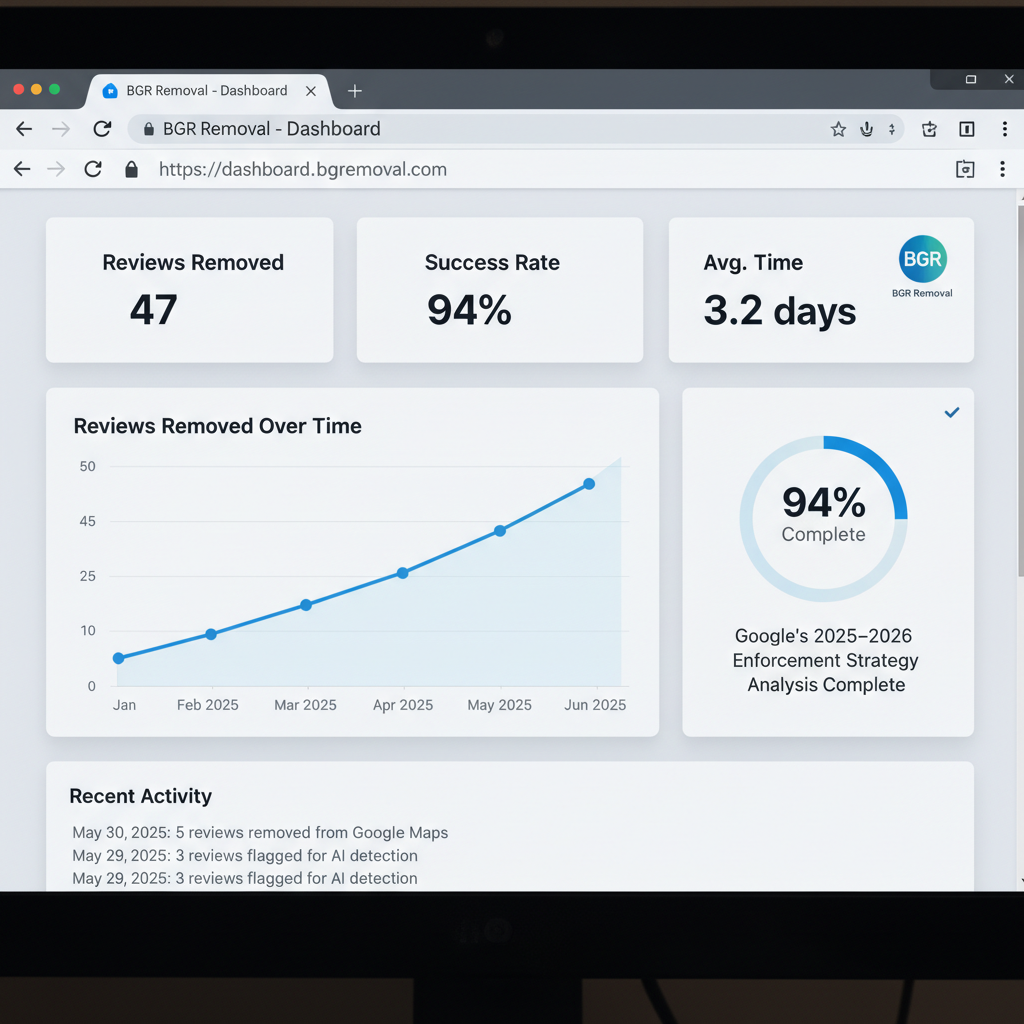
Dashboard showing review removal results and success metrics - AI-Generated Review Detection: Google’s 2025–2026 Enforcement Strategy
Conclusion: Taking the Next Steps
In closing, the challenge of AI-generated reviews is one that businesses cannot afford to ignore. Google's 2025–2026 enforcement strategy represents a pivotal moment in the ongoing battle for online authenticity. By understanding the intricacies of these new measures and adopting proactive strategies, businesses can maintain compliance and protect their hard-earned reputations.
For those seeking to delve deeper into the complexities of review management, our evidence guide for review removal offers practical tips and templates to assist in the process. Additionally, our insights into the FTC’s fake review crackdown provide valuable guidance on navigating regulatory challenges.
As the digital landscape continues to evolve, staying informed and adaptable is paramount. We invite you to reach out to our team for personalized advice and support in managing your online reputation. With the right strategies in place, you can confidently navigate the challenges posed by AI-generated reviews and emerge stronger than ever.
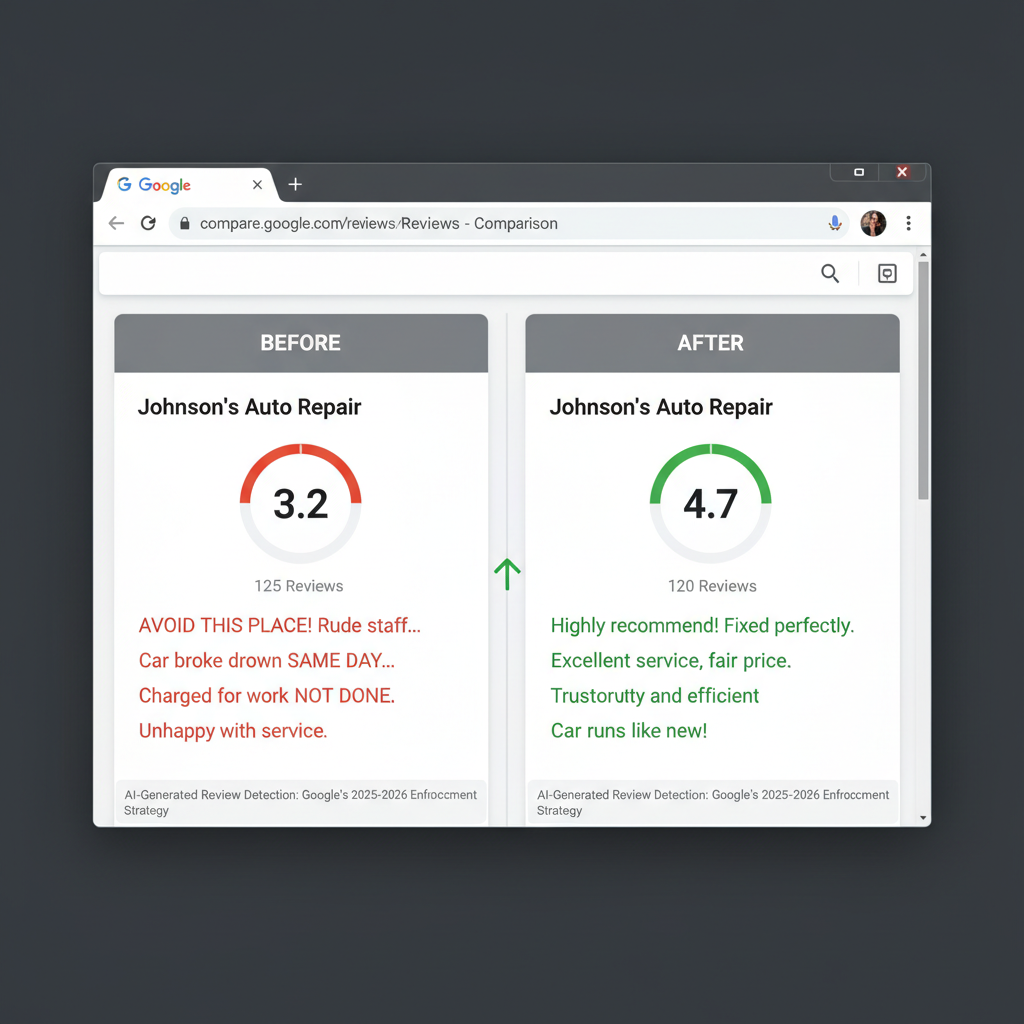
Before and after comparison showing improved business ratings - AI-Generated Review Detection: Google’s 2025–2026 Enforcement Strategy
Frequently Asked Questions
How does Google detect AI-generated reviews?
Google uses advanced machine learning and natural language processing technologies to detect AI-generated reviews. These systems analyze linguistic patterns, reviewer behavior, and other factors to identify content that appears unnatural or fabricated.
What are the consequences of hosting AI-generated reviews?
Businesses hosting AI-generated reviews risk having those reviews removed and potentially facing penalties from Google. This can include reduced visibility in search results, suspension of the business profile, or other corrective actions.
What strategies can businesses adopt to ensure compliance?
Businesses should focus on fostering genuine customer interactions and encouraging authentic feedback. Regularly auditing reviews and staying informed about Google's review policies are also critical steps in maintaining compliance.
Can AI-generated reviews be removed?
Yes, AI-generated reviews can be removed by reporting them to Google for violation of their authenticity guidelines. It’s important to provide clear evidence supporting the claim of inauthenticity.
How can businesses protect themselves from penalties?
To avoid penalties, businesses should prioritize transparency and ethical review practices. Implementing internal review verification processes and educating staff about Google’s guidelines can help safeguard against inadvertent violations.
What role does blockchain play in review authenticity?
Blockchain technology offers a way to verify review authenticity by recording them on an immutable ledger. While still emerging, it represents a promising method for ensuring transparency and trust in online reviews.