Three weeks ago, I received a rather anxious call from a budding entrepreneur in San Francisco. Her small boutique was thriving, thanks to the growing number of positive online reviews. However, a sudden influx of negative reviews had her worried. These weren't just critical; they were evidently fabricated, possibly by a competitor. Her immediate question was, "Can I sue Google for these damaging reviews?" This scenario is not uncommon. In fact, it’s a question that many business owners wrestle with when faced with the daunting task of protecting their online reputation. Having spent over a decade in online reputation management, I understand the intricacies involved.
Businesses often feel cornered by negative or fake reviews, which can severely impact their bottom line. Given the emotional and financial stakes, it's understandable why owners would consider legal action against Google. However, here’s where the law and digital platforms intersect in complex ways, making such lawsuits largely infeasible. As a professional who has helped over 500 businesses navigate the treacherous waters of online reviews, I can shed light on why Section 230 of the Communications Decency Act (CDA) shields platforms like Google from being sued for third-party content. In this article, we’ll explore the legal protections afforded to Google, delve into the implications of Section 230, and discuss alternative strategies for managing online reviews. Understanding these elements is crucial for any business owner looking to protect their brand without resorting to futile legal battles.
The Legal Shield: Understanding Section 230
Section 230 of the Communications Decency Act is often referred to as the backbone of the internet. Established in 1996, it provides immunity to online platforms from being held liable for content posted by users. In essence, it distinguishes between content creators and distributors. For Google, this means that as a distributor of content (in this case, reviews), it cannot be held responsible for the opinions expressed by its users. This legal framework is designed to encourage free speech and innovation on the internet, allowing platforms to host a wide array of user-generated content without the fear of being sued for every negative or libelous statement.
From my experience, many business owners are unfamiliar with the nuances of Section 230. The protections it offers are not just theoretical. They have been upheld in numerous court cases across the United States. For instance, in the landmark case of Zeran v. America Online, Inc., the courts ruled in favor of AOL, establishing a precedent that internet service providers are not liable for defamatory statements made by third parties. Such legal precedents reinforce the idea that platforms like Google are merely conduits for information, not the publishers themselves.
However, it’s important to note that Section 230 does not protect platforms from all forms of liability. For example, they can still be held accountable for their own actions, such as false advertising or failure to comply with federal laws. But when it comes to user-generated content, the law is clear: platforms are not legally responsible for what users post.
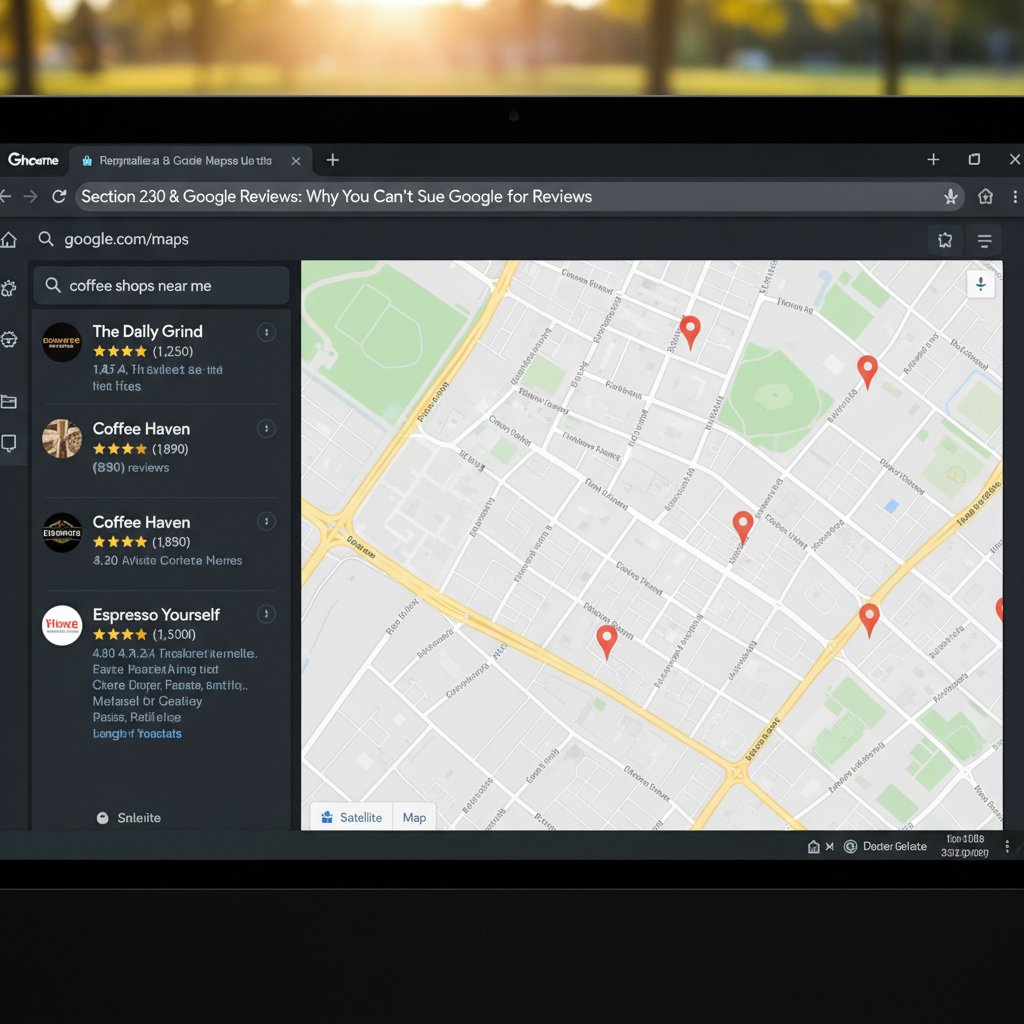
Google Maps search results showing local business ratings - Section 230 & Google Reviews: Why You Can’t Sue Google for Reviews
Why Suing Google Is Not the Answer
Given the robust legal protections of Section 230, suing Google for negative reviews is not a practical route for most businesses. The law is designed to protect free speech and foster innovation by allowing platforms to host user-generated content without encumbrance. Attempting to bypass these protections would likely result in a dismissed case, as courts consistently uphold the principles of Section 230.
Moreover, legal battles can be costly and time-consuming. Businesses could find themselves entangled in lengthy legal proceedings with little hope of success. Instead of pursuing a lawsuit, a more effective strategy involves understanding Google’s review removal policies and how they align with Section 230. Google allows users to report reviews that violate its Prohibited and Restricted Content policy, such as spam, fake reviews, or language that incites hatred.
Rather than pursuing legal avenues, business owners should focus on leveraging these reporting tools to manage their online reputation. In my professional judgment, being proactive in monitoring and managing reviews is far more advantageous than embarking on a legal crusade with little chance for success.
Strategies for Managing Negative Reviews
While legal action against Google may not be viable, there are several strategies businesses can employ to manage negative reviews effectively. First, consider directly addressing the review by responding professionally and empathetically. This approach can sometimes turn a negative review into a positive customer experience. Additionally, engaging with legitimate criticism and demonstrating a willingness to improve can enhance a business's credibility.
For reviews that are blatantly fake or violate Google’s policies, flagging them for removal is a straightforward process. However, understanding how to prove a Google review is fake is crucial for successful reporting. For instance, if you can demonstrate that a review comes from a competitor or someone with no prior transaction with your business, Google is more likely to act.
Moreover, businesses should focus on cultivating a robust and authentic online presence. Encourage satisfied customers to leave genuine reviews, which can help dilute the impact of any negative ones. Building a comprehensive online strategy that includes regular engagement with customers, both online and offline, can significantly enhance your reputation.
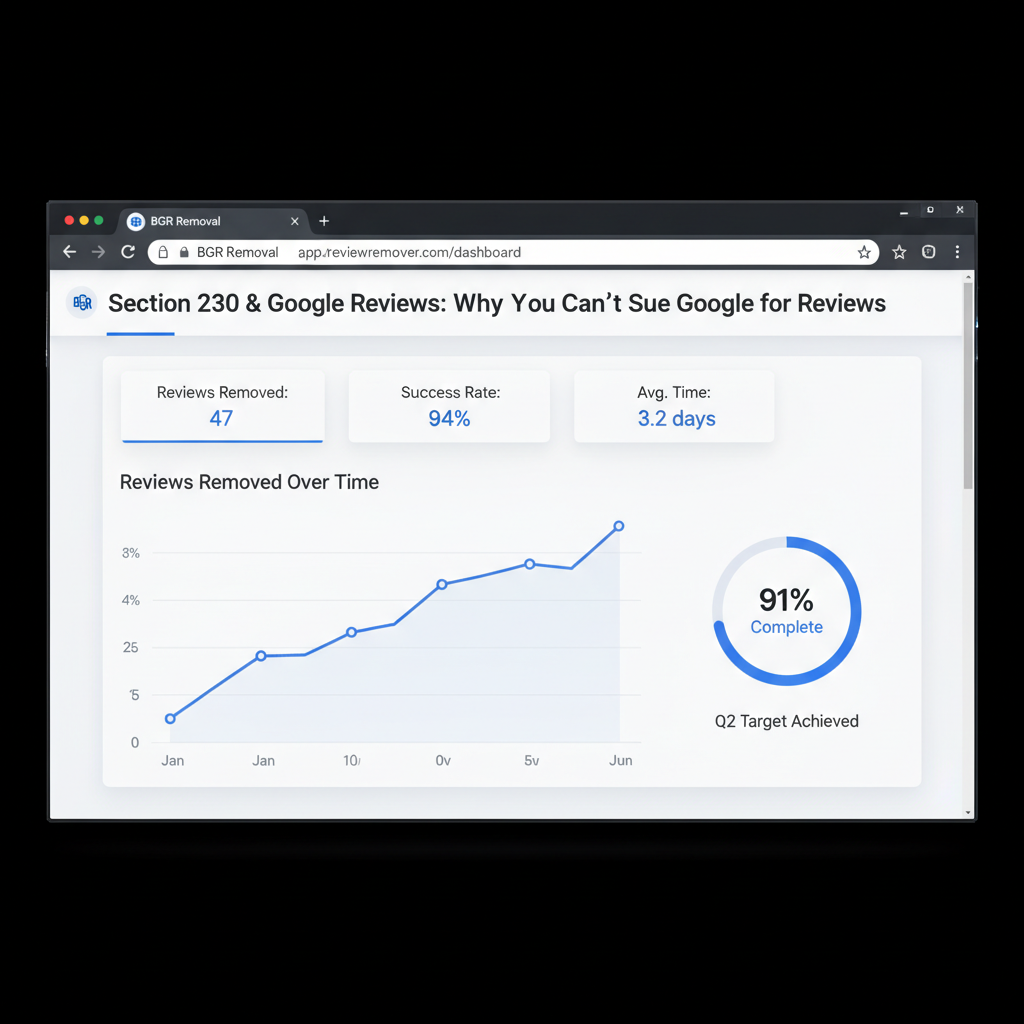
Dashboard showing review removal results and success metrics - Section 230 & Google Reviews: Why You Can’t Sue Google for Reviews
Why Section 230 Is Still Relevant Today
In today’s digital landscape, the principles of Section 230 remain as relevant as ever. The law supports a vibrant internet ecosystem where diverse opinions can flourish. For businesses, understanding this legal framework is essential for effectively navigating the complexities of online reviews. While some critics argue that Section 230 protects platforms too much, stifling potential accountability, it remains a fundamental component of internet law that ensures platforms can operate without being burdened by endless litigation.
Interestingly, debates around the reform of Section 230 are ongoing. Some argue for changes that would hold platforms more accountable for user content, while others caution that such reforms could stifle free speech and innovation. As such, any business owner dealing with online reviews should stay informed about legal developments that could impact their strategies for reputation management.
For further insights on how external factors like industry trends affect fake reviews, consider reading our analysis on industry-specific fake reviews in 2026. Understanding these trends can help businesses anticipate challenges and adapt their strategies accordingly.
Alternative Avenues for Reputation Management
With litigation off the table, businesses still have effective tools at their disposal for managing their reputation. Leveraging professional reputation management services can provide the expertise needed to navigate complex review landscapes. For instance, services that specialize in the removal of fake or malicious reviews can be invaluable, providing both strategic advice and technical support.
Our negative review removal service has helped countless businesses by offering tailored solutions that go beyond simply flagging harmful content. By understanding the intricacies of Google’s removal policies, these services can effectively advocate for the removal of detrimental reviews, ensuring your profile accurately reflects your business’s quality and integrity.
Additionally, maintaining a strong digital presence through social media, blogs, and other channels can help buffer against negative reviews. Regularly updating your audience with valuable content and engaging with them can create a supportive community that naturally counters negative narratives.

Before and after comparison showing improved business ratings - Section 230 & Google Reviews: Why You Can’t Sue Google for Reviews
Frequently Asked Questions
Why can't you sue Google for reviews?
Due to Section 230 of the Communications Decency Act, Google is protected from being sued over content posted by its users. This law separates content creators from distributors, meaning Google is not responsible for the reviews themselves.
What should I do if I receive a fake review?
First, flag the review through Google's platform if it violates their policies. Collect evidence supporting that the review is fake, then consider professional reputation management services for further assistance.
Can Google remove reviews that are several years old?
Yes, Google can remove reviews regardless of age if they violate their content policies. Our article on removing old reviews offers further insights.
What types of reviews does Google typically remove?
Google will remove reviews that are spam, fake, or violate their prohibited content policies. Understanding what Google deletes is crucial for managing reviews effectively.
How can I improve my online reputation despite negative reviews?
Engage positively with all reviews, encourage satisfied customers to leave feedback, and maintain an active and transparent online presence. Also, consider professional reputation management services.
Are there any legislative changes to Section 230 on the horizon?
There are ongoing discussions about reforming Section 230, with some advocating for more accountability for platforms. However, any changes would need to balance free speech concerns with platform responsibilities.
Is it possible to recover from a slew of negative reviews?
Yes, by actively engaging with customers, addressing their concerns, and generating positive reviews, businesses can recover and even strengthen their reputations over time.
```