It was a chilly Tuesday morning when the phone rang incessantly, pulling me out of my morning routine. On the other end was a small business owner from Seattle, whose voice carried a mix of frustration and urgency. She had just discovered multiple negative reviews on her Google Business Profile, purportedly from customers she'd never served. This scenario is all too familiar. In my 8+ years specializing in online reputation management, I've encountered countless cases where business owners find themselves at the mercy of false or malicious reviews. These situations can be a nightmare, potentially damaging your hard-earned reputation and affecting your bottom line.
For many business owners, the Google review ecosystem is akin to navigating a jungle. The uncertainty of which reviews are legitimate and which are not can be overwhelming. If you've ever felt powerless against the onslaught of unjustified bad reviews, you're not alone. From my experience working with hundreds of businesses, I understand that clarity on what can and cannot be removed is paramount.
Our expertise at BGR Removal spans over a decade, during which we've successfully facilitated the removal of thousands of reviews. Whether you're dealing with fake reviews, inappropriate content, or reviews that violate Google's policies, knowing what can be removed and how is crucial. This article will delineate the types of Google reviews eligible for removal, why it matters, and how you can protect your business from online defamation. By the end, you'll have a clearer roadmap to maintaining your online reputation, armed with strategies to tackle even the most persistent review issues.
Understanding Google's Content Policies
To effectively manage your online reputation, it's essential to first grasp the intricacies of Google's review policies. Google's Prohibited and Restricted Content policy outlines what types of content are not allowed on their platform. This policy serves as a guideline for determining which reviews can be flagged for removal. Commonly, reviews that contain hate speech, harassment, explicit content, or spam fall into this category. In addition, any content that misleads or directly violates Google's policies such as fake reviews can be contested.
Google's policies are designed to provide a fair platform for both businesses and consumers. However, enforcement can sometimes feel inconsistent. While Google's systems and community flagging mechanisms aim to maintain quality, some inappropriate content slips through the cracks. This is where understanding the specifics of these policies becomes crucial. Knowing which reviews can be removed can save businesses from unwarranted reputational damage.
Google Maps search results showing local business ratings - What type Of Google Reviews can Be Removed?
Fake Reviews: A Persistent Threat
One of the most damaging types of reviews for any business is the fake review. From my experience, fake reviews are not just limited to negative comments. They can also include overly positive reviews from fake accounts aimed at manipulating your ratings. According to a survey by the FTC, fake reviews can severely mislead consumers and unfairly distort market competition.
Google's automated systems and user reports attempt to catch these fraudulent reviews. However, sophisticated tactics used by some malicious actors can make detection challenging. For instance, fake reviews may be posted by competitors or disgruntled former employees, hiding under the guise of anonymity. Despite these challenges, Google does allow businesses to report fake reviews for evaluation. The process involves identifying the review, providing evidence, and sometimes, directly contacting Google support to expedite the removal process.
Inappropriate Content and Policy Violations
Content that directly violates Google's content guidelines is also subject to removal. This includes reviews that contain profanity, discriminatory remarks, or explicit content. In one of our most notable cases, a client was targeted by a series of reviews containing racial slurs. By flagging these reviews and providing Google with the necessary context, we were able to have them removed swiftly.
Another common policy violation is the presence of promotional content masquerading as reviews. This includes advertising external services or products, which is strictly against Google's guidelines. Businesses should regularly monitor their reviews to identify and report such violations. Engaging in review monitoring using tools like Google Alerts or third-party services can provide an extra layer of protection against inappropriate content.
Conflict of Interest and Biased Reviews
Google also takes a firm stance against reviews that present a conflict of interest. These include reviews written by current or former employees intended to either artificially inflate or deflate a business's rating. Our experts have successfully navigated the removal of such reviews by demonstrating the relationship between the reviewer and the business, thus highlighting the conflict of interest.
Biased reviews, though more subjective, can also be challenged if evidence of bias such as repeated patterns of similar reviews across competitors is evident. In my experience, presenting a well-documented case to Google, often with screenshots and timelines, can be instrumental in achieving review removal in these instances.
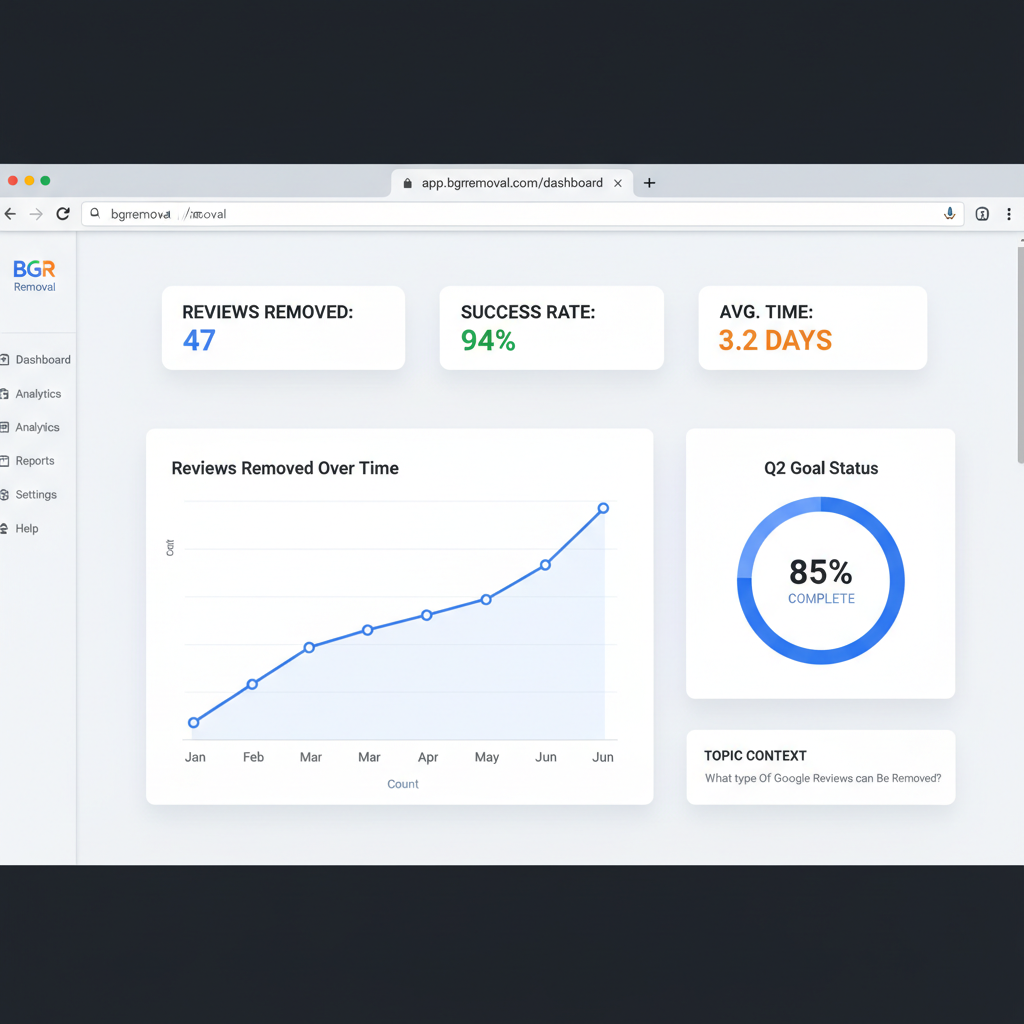
Dashboard showing review removal results and success metrics - What type Of Google Reviews can Be Removed?
Technical Errors and Misplaced Reviews
Occasionally, a legitimate review may end up on the wrong business's profile due to technical errors. For instance, I remember handling a case where a hotel in New York received a review meant for a similarly named establishment across the country. While rare, these errors can be detrimental, especially if the misplaced review is negative.
When such situations arise, it's important to contact Google support with clear evidence of the error. Typically, this includes showing the discrepancy between the review's content and your business's offerings. Google usually rectifies these issues once sufficient proof is provided, though the process may take some time.
Steps to Request Review Removal
Understanding the types of reviews that can be removed is only part of the equation. The next step involves knowing how to request removal. Businesses should start by logging into their Google Business Profile and identifying the offending review. From there, the review can be flagged for removal by selecting the appropriate option that describes the violation. Providing additional context or documentation can expedite the process.
For more complex cases, reaching out to Google's support team directly can be an effective strategy. However, businesses should be prepared for a potentially lengthy process, as Google's review policies require detailed verification. Patience and persistence are key, and in some cases, seeking professional assistance from a negative review removal service can be beneficial.
For further insights on Google's policies, you can explore our detailed guide on Google Review Removal Policies, which breaks down the criteria for removals in depth, ensuring you’re well-equipped to handle such challenges independently.
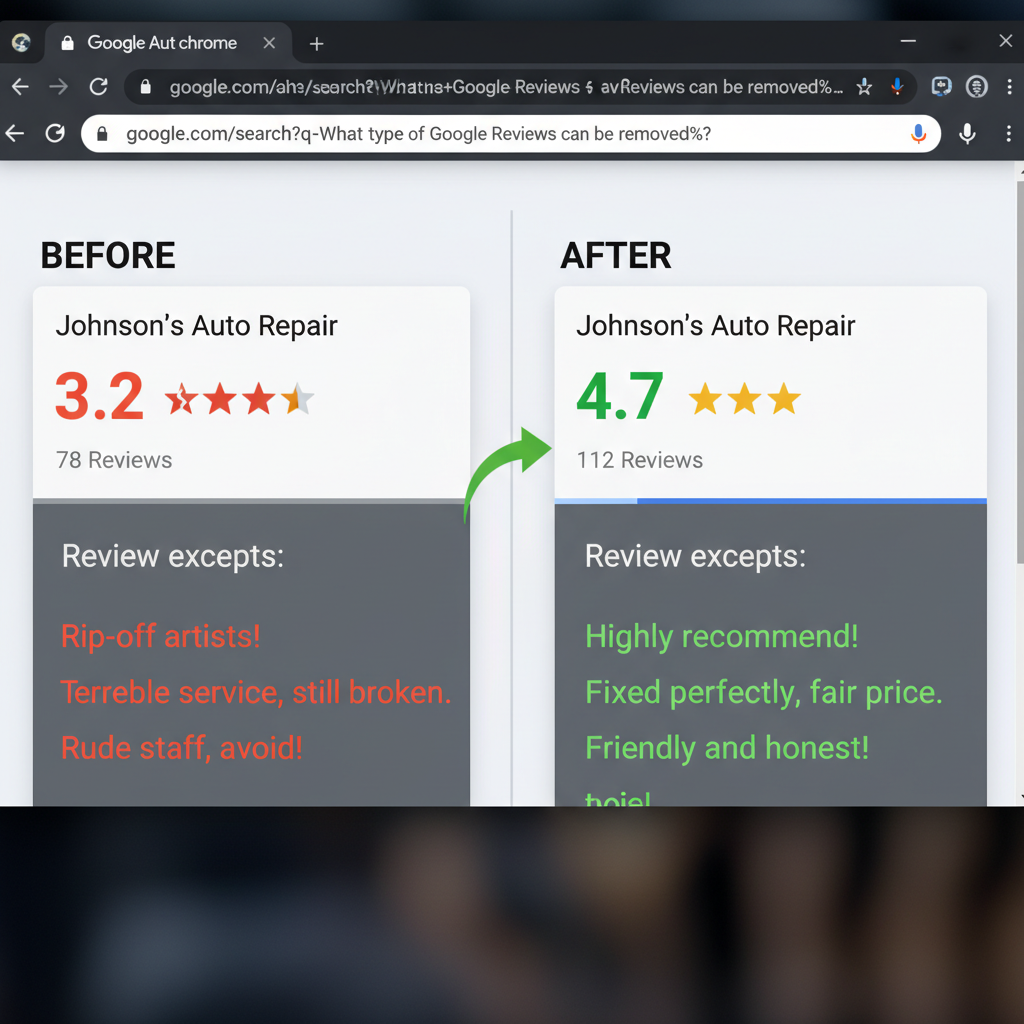
Before and after comparison showing improved business ratings - What type Of Google Reviews can Be Removed?
Conclusion
In the digital age, where a single review can significantly influence consumer behavior, understanding what types of Google reviews can be removed is crucial for sustaining a positive online presence. From fake to inappropriate reviews, knowing how to navigate Google's policies can protect your business's reputation and maintain consumer trust. While challenging, the process is not insurmountable. Armed with the right knowledge and perhaps a bit of professional guidance, businesses can effectively manage and mitigate the impact of harmful reviews.
If you’re looking to explore further strategies, consider reading our article on Local SEO Ranking Factors, which delves into the broader impact of reviews on your business’s online visibility. Additionally, our Google Review Generation guide offers insights into cultivating a robust collection of positive reviews, ensuring that your business remains competitive in the crowded digital marketplace.
Frequently Asked Questions
What types of reviews are eligible for removal?
Reviews containing hate speech, explicit content, fake identities, promotional content, and those that violate Google's content policies are eligible for removal.
How long does it take for Google to remove a review?
The timeline varies, but typically, Google reviews flagged for removal take several days to a few weeks for evaluation and potential removal.
Can I remove a review if I simply don't agree with it?
No, differing opinions or valid criticisms do not qualify for removal unless they violate specific Google content policies.
What evidence do I need when reporting a fake review?
Providing screenshots, timelines, and any corroborating evidence that illustrates the review's inauthenticity can strengthen your case for removal.
Is there a way to prevent fake reviews?
While prevention isn't foolproof, monitoring tools and maintaining open communication with customers can help mitigate the impact of fake reviews.
How do I handle a negative review that cannot be removed?
Respond professionally, addressing the customer's concerns and demonstrating your commitment to service improvement. For templates and best practices, check our article on Responding to Negative Reviews.
Are there professional services that can help with review removal?
Yes, professional services like ours specialize in navigating complex review removal processes, ensuring your business's online reputation remains intact.